
Ayurveda
History of Ayurveda
Originated Around 5000 BCE
Ayurveda is one of the world’s oldest holistic healing systems, with its roots dating back to around 5000 BCE in the Indian subcontinent. The term Ayurveda is derived from the Sanskrit words Ayur (life) and Veda (knowledge), meaning “the science of life.” Unlike modern medical systems that often focus on treating symptoms, Ayurveda emphasizes understanding the individual as a whole—body, mind, and spirit. This ancient science developed through close observation of nature, human physiology, seasonal cycles, and lifestyle patterns. Early Ayurvedic scholars documented their insights through oral traditions before they were compiled into classical texts such as the Charaka Samhita and Sushruta Samhita. These texts describe principles of health, disease prevention, nutrition, surgery, herbal medicine, and mental well-being. Ayurveda identifies health as a dynamic balance between the 3 Doshas—Vata, Pitta, and Kapha—along with proper digestion (Agni), tissue nourishment (Dhatus), waste elimination (Malas), and mental harmony. Disease is seen not as a sudden occurrence but as a gradual imbalance that develops over time due to lifestyle, diet, stress, and environmental factors. What makes Ayurveda timeless is its preventive approach. It teaches individuals how to live in harmony with nature, adapt to seasonal changes, and follow daily routines (Dinacharya) for long-term wellness. Even after thousands of years, the foundational philosophy of Ayurveda remains relevant, offering natural solutions for sustainable health and longevity.
Ayurvedic Incarnation (Divine Lineage of Knowledge)
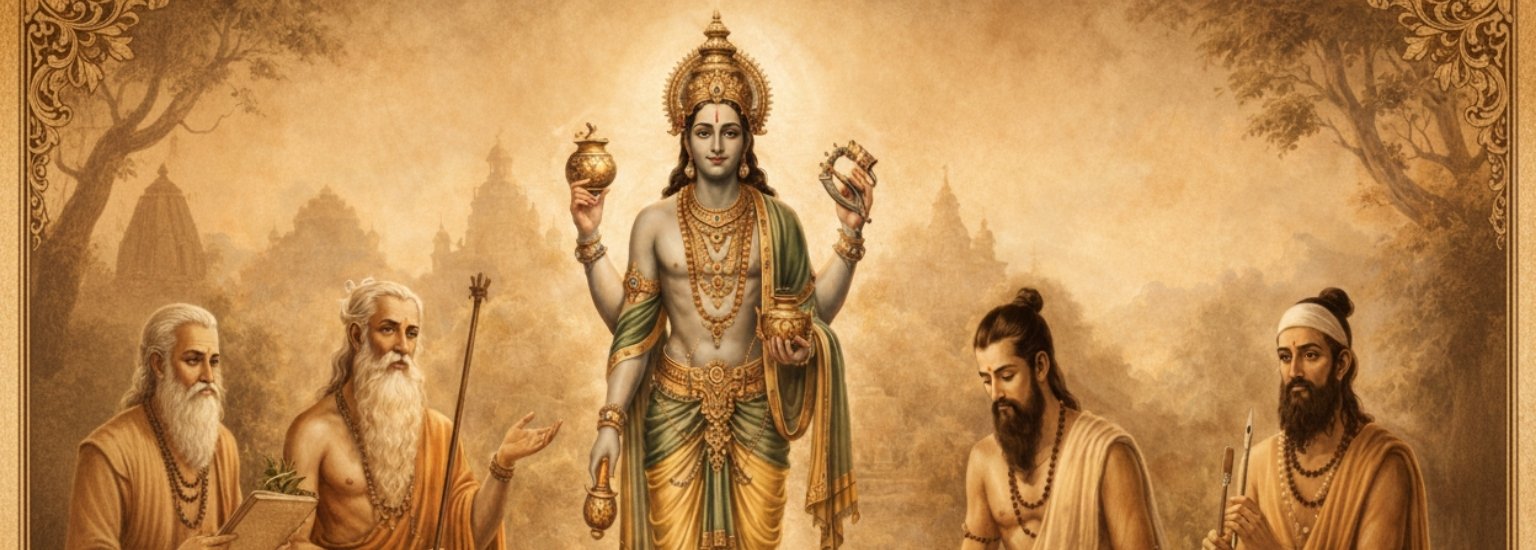
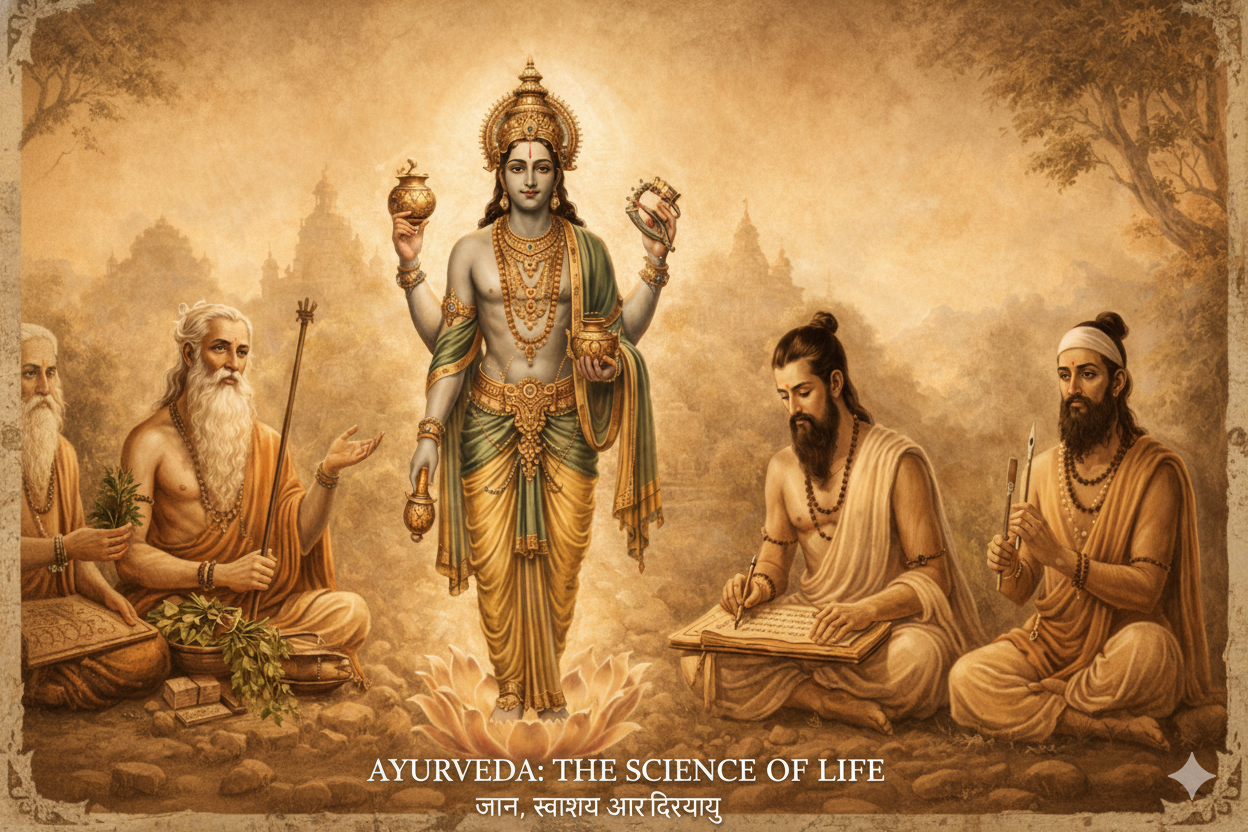
According to ancient Indian tradition, Ayurvedic knowledge is believed to have a divine origin. The wisdom of Ayurveda is said to have originated from Brahma, the creator in Hindu philosophy, who possessed complete knowledge of life and the universe. This sacred science was then transmitted to Daksha Prajapati, who further passed it down through a lineage of enlightened beings. From Daksha Prajapati, Ayurvedic wisdom reached the Ashwini Kumaras, the celestial physicians of the gods, known for their exceptional healing abilities. The Ashwini Kumaras conveyed this knowledge to Indra, the king of the Devas, who recognized the importance of Ayurveda for preserving life and vitality among both divine and human beings. Indra then imparted this sacred science to Bhagwan Dhanvantari, regarded as the divine physician and the principal deity of Ayurveda. Dhanvantari is believed to have emerged during the Samudra Manthan (churning of the ocean), holding the nectar of immortality (Amrit) and the science of healing. This divine lineage reflects Ayurveda’s spiritual foundation. It highlights that Ayurveda is not merely a medical system but a sacred life science designed to preserve balance, harmony, and longevity. The transmission of knowledge from divine beings to humanity symbolizes Ayurveda’s role as a guiding force for ethical living, a disciplined lifestyle, and holistic well-being.
Evolved Through Sages
While Ayurveda has divine origins, its practical development occurred through the dedicated work of ancient sages (Rishis). These enlightened scholars refined Ayurvedic knowledge through years of observation, experimentation, and clinical practice. Living close to nature, they studied the effects of herbs, minerals, diet, climate, and human behavior on health and disease. Great sages such as Charaka, Sushruta, and Vagbhata played a vital role in systematizing Ayurveda. The Charaka Samhita focused primarily on internal medicine, diagnosis, and preventive healthcare, while the Sushruta Samhita laid the foundation for surgery, anatomy, and trauma care. These texts demonstrate a remarkable understanding of human physiology, surgical instruments, and medical ethics—far ahead of their time. Ayurvedic sages emphasized personalized treatment, recognizing that every individual has a unique constitution (Prakriti). They introduced detailed diagnostic methods using pulse examination, observation, and patient history. Treatment plans were designed to restore balance rather than suppress symptoms. The oral tradition ensured that Ayurvedic knowledge was preserved and passed down through generations with discipline and accuracy. Over centuries, this collective wisdom evolved into a comprehensive healthcare system that addressed physical ailments, mental health, reproductive health, and spiritual growth. The sages’ contributions transformed Ayurveda into a living science—adaptive, practical, and deeply rooted in human experience.
Revived After Independence
During the colonial period, Ayurveda faced a significant decline as Western medicine became dominant. Many traditional institutions lost support, and indigenous knowledge systems were sidelined. However, after India’s independence in 1947, Ayurveda experienced a structured revival as part of the nation’s cultural and healthcare identity. The Indian government began recognizing Ayurveda as a valuable medical system with deep historical roots and practical relevance. Educational institutions were established to standardize Ayurvedic education, research, and clinical practice. Degree programs such as BAMS (Bachelor of Ayurvedic Medicine and Surgery) were introduced to integrate classical wisdom with modern scientific understanding. Post-independence efforts also focused on documenting traditional knowledge, reviving classical texts, and encouraging scientific research on herbal formulations. Ayurveda was repositioned not as an alternative, but as a complementary system capable of contributing to preventive healthcare and chronic disease management. Public awareness increased as people began seeking natural, side-effect-free approaches to health. Ayurveda’s emphasis on lifestyle correction, diet, detoxification, and stress management aligned well with modern health challenges. This revival restored Ayurveda’s credibility and ensured its survival as a respected, regulated, and evolving healthcare system in contemporary India.
CCRAS Formed in 1969
The Central Council for Research in Ayurvedic Sciences (CCRAS) was established in 1969 to promote scientific research in Ayurveda. Its formation marked a significant step toward validating traditional Ayurvedic knowledge through systematic research and evidence-based studies. CCRAS operates under the Government of India and is responsible for conducting clinical trials, drug research, literary studies, and epidemiological surveys related to Ayurveda. The council has played a crucial role in bridging the gap between classical Ayurvedic principles and modern scientific methodologies. Through its network of research institutes across India, CCRAS has contributed to the standardization of formulations, documentation of medicinal plants, and development of treatment protocols for various diseases. It has also supported collaborative research with modern medical institutions to explore integrative healthcare models. By focusing on quality, safety, and efficacy, CCRAS has strengthened the global credibility of Ayurveda. Its work ensures that Ayurveda continues to evolve while remaining rooted in its traditional foundations, making it relevant for present and future generations.
WHO Recognition in 2002
In 2002, Ayurveda gained international acknowledgment when the World Health Organization (WHO) recognized traditional medicine as an important component of global healthcare. This recognition highlighted the relevance of systems like Ayurveda in primary healthcare, disease prevention, and wellness promotion. WHO emphasized the role of traditional medicine in addressing healthcare accessibility, especially in developing countries. Ayurveda’s holistic approach, focus on prevention, and use of natural resources aligned well with the WHO’s vision of sustainable and inclusive healthcare. Following this recognition, Ayurveda gained greater acceptance in global research, education, and policy discussions. Many countries began exploring Ayurvedic therapies, herbal medicines, and wellness practices as complementary healthcare options. WHO’s acknowledgment encouraged standardization, quality control, and safety guidelines for Ayurvedic products worldwide. It also opened doors for international collaboration, helping Ayurveda transition from a traditional system to a globally respected health science.
Ministry of AYUSH Established in 2014
The Ministry of AYUSH was established in 2014 to provide focused governance for traditional systems of medicine, including Ayurveda, Yoga, Unani, Siddha, and Homeopathy. This dedicated ministry strengthened policy-making, education, research, and global promotion of Ayurveda. The ministry works to standardize Ayurvedic education, regulate practitioners, ensure quality control of medicines, and support scientific research. It also promotes international cooperation, helping Ayurveda gain recognition across the world. By integrating Ayurveda into national health programs, the Ministry of AYUSH has reinforced its role in preventive healthcare, lifestyle disorders, and wellness tourism. Its formation marked a new era of institutional support and global outreach for Ayurveda.
Ayurveda Day Declared 2025
The declaration of "Ayurveda Day" marks a significant milestone in the global recognition of Ayurveda’s contribution to human health and holistic well-being. Starting in 2025, India observes Ayurveda Day annually on September 23, as officially declared by the Ministry of AYUSH. Earlier, Ayurveda Day was celebrated on Dhanteras, but the shift to a fixed date was introduced to ensure consistency, better global participation, and long-term international planning. Ayurveda Day is celebrated to honor Bhagwan Dhanvantari, the divine physician and symbol of healing in Ayurvedic tradition. The observance highlights Ayurveda’s preventive philosophy, scientific foundation, and holistic approach that focuses on balance between body, mind, and environment rather than mere disease management. This day serves as a national and global platform to promote healthy living, natural therapies, and sustainable healthcare practices. Under the coordination of the Ministry of AYUSH, celebrations include nationwide awareness campaigns, free Ayurvedic health camps, seminars, wellness consultations, and youth-focused educational programs. These initiatives aim to connect traditional Ayurvedic wisdom with modern lifestyle needs. Key focus areas of Ayurveda Day include preventive healthcare, management of lifestyle disorders, sustainable living, and the concept of “Agro-Ayurveda,” which emphasizes the relationship between agriculture, medicinal plants, and health. The fixed observance date strengthens India’s commitment to traditional medicine while positioning Ayurveda as a credible, scientific, and globally relevant healthcare system. Ultimately, Ayurveda Day reinforces Ayurveda’s timeless message: true health is not merely the absence of disease, but a state of physical vitality, mental clarity, emotional balance, and harmony with nature.
Introduction
Ayurveda means “Knowledge of Life” and represents a holistic system of health that emphasizes harmony between the body, mind, and environment. Rooted in ancient wisdom, Ayurveda views health not merely as freedom from disease, but as a balanced state of physical strength, mental clarity, and emotional well-being. At the core of Ayurveda lies the concept of the three fundamental energies, known as Vata, Pitta, and Kapha. These Doshas govern all physiological and psychological functions of the body. Vata controls movement and nervous functions, Pitta regulates digestion and metabolism, while Kapha provides structure, stability, and immunity. Health is maintained when these three Doshas remain in balance. Ayurveda recognizes that every individual is born with a unique constitution, known as Prakriti. This inherent balance of Doshas determines a person’s physical traits, metabolism, emotional tendencies, and overall personality. Understanding one’s Prakriti helps in choosing the right diet, lifestyle, and daily routines for long-term wellness. By focusing on personalized care rather than a one-size-fits-all approach, Ayurveda empowers individuals to take responsibility for their health and live in alignment with nature.