
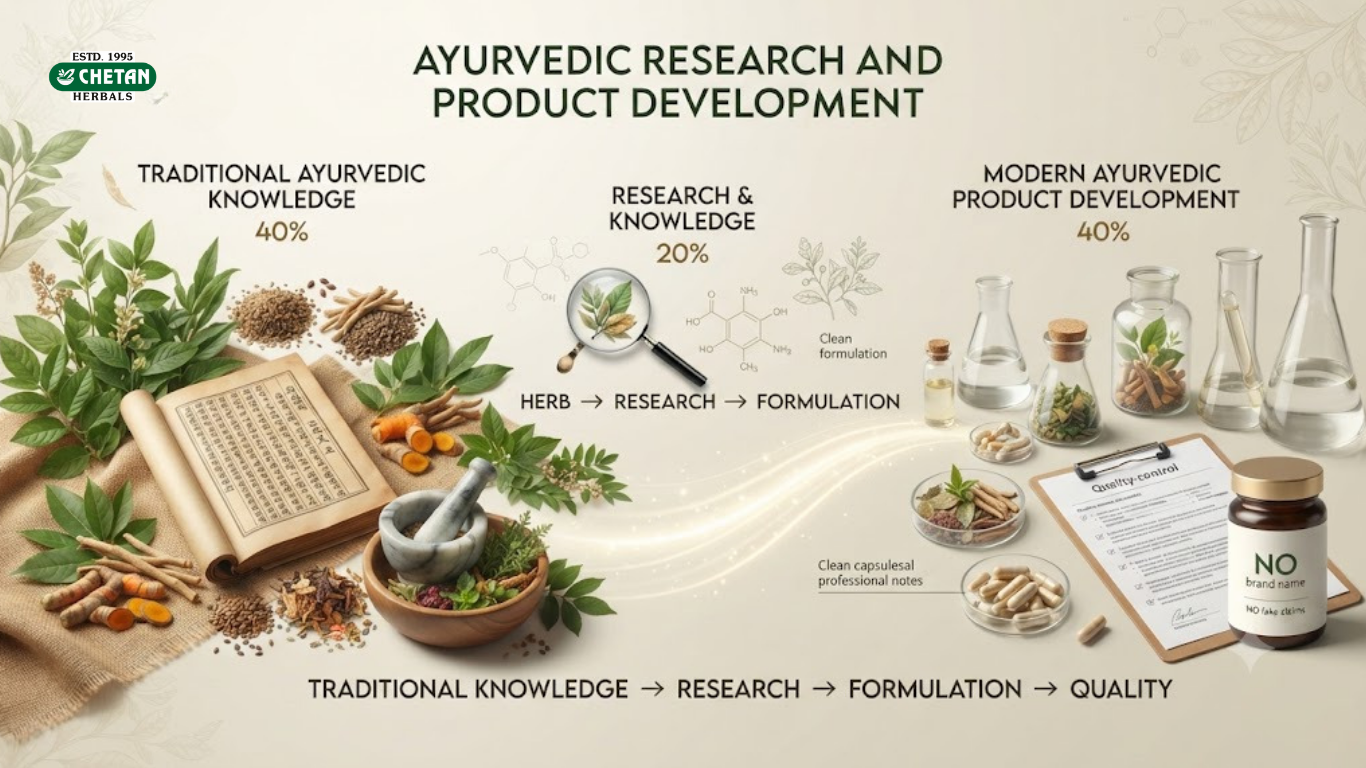
Ayurveda is a traditional system of medicine with a vast body of classical knowledge covering herbs, formulations, diet, lifestyle and preventive health. At Chetan Herbals, our Ayurvedic Research and Product Development approach focuses on studying this traditional knowledge carefully and considering how it can be applied responsibly to the development and evaluation of Ayurvedic wellness products.
Chetan Herbals works with a multidisciplinary team that includes Ayurvedic practitioners and pharmacy expertise. The organisation also collaborates with Ayurved Apnao, an initiative focused on increasing awareness and understanding of Ayurveda.
Our objective is not simply to manufacture Ayurvedic products. We aim to continuously improve our understanding of Ayurvedic ingredients, traditional formulations, product quality and their appropriate role in modern wellness.
What Does “Research” Mean at Chetan Herbals?
The word research can have several meanings. Clinical research, laboratory research, literature research and practitioner-based evaluation are different activities and should not be presented as the same thing.
At Chetan Herbals, research and knowledge-development activities may include:
- studying classical Ayurvedic literature and traditional uses of herbs;
- reviewing available scientific literature relating to ingredients;
- examining the rationale behind combinations of Ayurvedic ingredients;
- discussing formulations with experienced Ayurvedic practitioners;
- reviewing product composition, dosage form and practical usability;
- considering quality, manufacturing and pharmacy-related aspects;
- collecting structured observations and feedback where appropriate; and
- periodically reviewing formulations in light of traditional knowledge and newer published information.
Unless specifically stated with supporting evidence, these activities should not be interpreted as proof from a randomized clinical trial or as evidence that a product can diagnose, prevent, treat or cure a particular disease.
Bringing Ayurvedic Practitioners and Pharmacy Expertise Together
Ayurvedic product development can benefit from more than one type of professional perspective.
Ayurvedic practitioners contribute their understanding of traditional Ayurvedic principles, herbs, formulations, diet and lifestyle. Pharmacy expertise contributes an additional perspective on areas such as formulation, dosage forms, ingredients, manufacturing processes, documentation and product quality.
This multidisciplinary approach is an important part of Chetan Herbals’ knowledge-development process.
Chetan Herbals’ Ayurveda Knowledge Team
The broader Chetan Herbals team includes Ayurvedic practitioners and pharmacy expertise who contribute to discussions around Ayurveda, traditional formulations, product knowledge and health education.
Vaidya Dr. Chetan Gupta
Vaidya Dr. Chetan Gupta is associated with the leadership and Ayurvedic knowledge initiatives of Chetan Herbals. His clinical experience contributes a practitioner’s perspective to discussions involving Ayurveda, men’s wellness, lifestyle and traditional formulations.
Mamta Gupta — Director, B.Pharmacy
Mamta Gupta, Director at Chetan Herbals and a B.Pharmacy graduate, contributes a pharmacy-oriented perspective to the organisation. This is particularly relevant when Ayurvedic knowledge needs to be considered alongside formulation, ingredients, dosage forms, manufacturing and product-quality processes.
Ayurvedic Practitioner Team
The team also includes:
- Dr. Anil Goswami
- Dr. Mohan Lal
- Dr. Kamal Kumar
- Dr. Ashok Krishna
- Dr. Om Pal Singh
- Dr. Raj Pal Saini
- Dr. Pradeep Pathak
Their professional roles, qualifications and specific contributions should be stated individually wherever they can be independently documented.
Chetan Herbals’ wider team also contributes to product development, manufacturing, quality processes, documentation and Ayurveda awareness activities according to their respective responsibilities.
Collaboration with Ayurved Apnao
Chetan Herbals also works alongside Ayurved Apnao in activities aimed at promoting awareness and responsible understanding of Ayurveda.
The purpose of Ayurveda awareness should extend beyond promoting individual products. People should also have access to understandable information about Ayurvedic principles, traditional herbs, healthy lifestyle practices and the limitations of self-medication.
Through educational initiatives, practitioner participation and public awareness activities, the collaboration seeks to make reliable Ayurveda-related knowledge easier for the public to understand.
How an Ayurvedic Product Is Evaluated
Before discussing an Ayurvedic formulation, several questions are useful:
What is the traditional rationale for its ingredients?
The classical or traditionally documented uses of individual ingredients should first be understood.
Why are particular ingredients combined?
A formulation should have a rationale rather than being viewed merely as a long list of herbs.
What does contemporary research say?
Where relevant scientific literature exists, it should be reviewed while distinguishing research on an individual ingredient from evidence for the finished formulation.
Is the available evidence directly applicable to the product?
Evidence about one herb cannot automatically prove the effectiveness of a multi-ingredient commercial product.
What are the safety considerations?
Dose, duration, individual health conditions, concurrent medicines and the need for professional supervision should be considered where relevant.
Traditional Ayurvedic Knowledge and Modern Scientific Evidence Are Not the Same
This distinction is fundamental to responsible Ayurveda communication.
A herb may have centuries of documented traditional use. Modern laboratory or clinical studies may also investigate that herb. However, these are different forms of evidence.
Traditional use should not automatically be described as clinical proof. Similarly, preliminary laboratory findings should not be presented as proof that a finished product will produce the same effect in people.
Chetan Herbals aims to maintain this distinction when reviewing and communicating information about Ayurveda and its products.
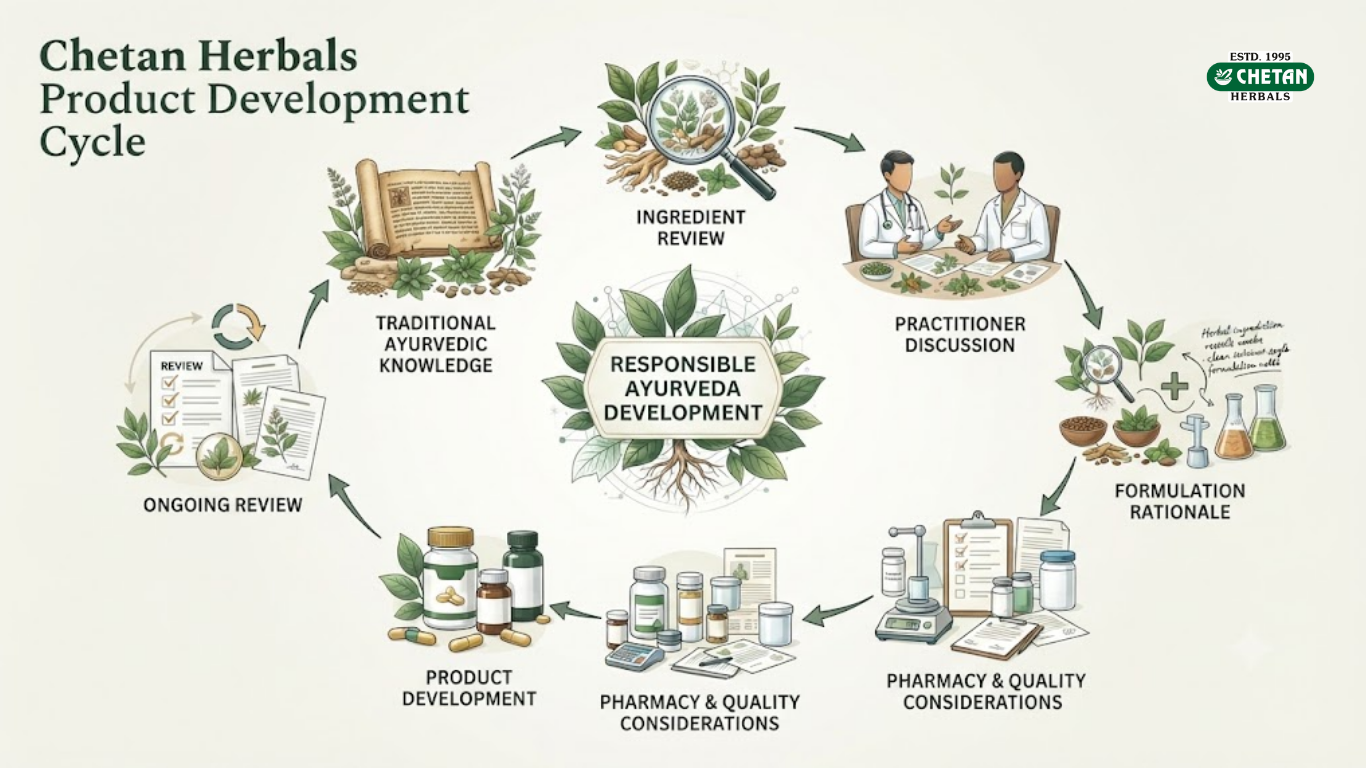
Ayurvedic Research & Product Development
Our Approach to Product Development
Our preferred approach can be summarised as:
Traditional Ayurvedic knowledge → ingredient review → practitioner discussion → formulation rationale → pharmacy and quality considerations → product development → ongoing review.
As additional reliable information becomes available, existing knowledge and formulations can be reviewed again.
This makes product development an ongoing process rather than a one-time exercise.
Why Practitioner Experience Still Matters
Published research is important, but practitioners encounter another important source of information: real-world questions from people.
Patients and consumers may differ considerably in age, lifestyle, diet, sleep, stress, existing medical conditions and medicine use. These differences are one reason why responsible health advice should not assume that one formulation is suitable for everyone.
Practitioner experience can help identify questions worth investigating further, but clinical observations alone should not be presented as controlled scientific evidence.
Areas of Continuing Interest
Chetan Herbals’ Ayurveda knowledge and product-development work is particularly interested in areas such as:
Men’s wellness and vitality — understanding traditional Ayurvedic approaches alongside lifestyle factors and contemporary evidence.
Healthy weight and nutrition support — studying herbs traditionally associated with nourishment, digestion and general wellness.
Metabolic wellness — examining traditional ingredient knowledge while recognising the importance of conventional medical monitoring for metabolic disorders.
Joint and musculoskeletal wellness — studying traditional approaches to physical comfort and mobility.
General vitality and healthy ageing — examining Rasayana concepts and the evidence available for commonly used Ayurvedic ingredients.
These areas represent fields of interest and should not be interpreted as claims that a particular Chetan Herbals product has been clinically proven to treat a disease.
Frequently Asked Questions
Does Chetan Herbals conduct research on Ayurvedic products?
Chetan Herbals undertakes ongoing knowledge-development and product-evaluation activities involving traditional Ayurvedic literature, ingredient information, available scientific literature, practitioner discussions, formulation rationale and pharmacy or quality considerations. Any specific laboratory or clinical study should be identified separately with its methodology and results.
Does traditional Ayurvedic use mean an ingredient is scientifically proven?
No. Traditional use and modern clinical evidence are different forms of information. Traditional knowledge can provide an important rationale for studying an ingredient, but claims of clinical effectiveness require appropriate scientific evidence.
Who contributes to Chetan Herbals’ Ayurveda knowledge initiatives?
The broader team includes Vaidya Dr. Chetan Gupta, Director Mamta Gupta (B.Pharmacy), Ayurvedic practitioners including Dr. Anil Goswami, Dr. Mohan Lal, Dr. Kamal Kumar, Dr. Ashok Krishna, Dr. Om Pal Singh, Dr. Raj Pal Saini and Dr. Pradeep Pathak, together with other members of the Chetan Herbals team according to their respective roles.
What is the role of Ayurved Apnao?
Ayurved Apnao works on Ayurveda awareness and education initiatives. Its association with Chetan Herbals can support educational activities intended to improve public understanding of Ayurveda, traditional wellness practices and responsible use of Ayurvedic knowledge.
Are Chetan Herbals products clinically proven?
A product should be described as clinically proven only when adequate product-specific clinical evidence supports that statement. Traditional use of ingredients, practitioner experience or research concerning individual herbs should not by themselves be presented as clinical proof of a finished product.
A Commitment to Responsible Ayurveda Communication
Ayurveda has a long intellectual and clinical tradition. Preserving that tradition also requires communicating it responsibly.
For Chetan Herbals, building Ayurveda knowledge means asking not only “What does Ayurveda say?” but also “What evidence supports this statement?”, “What are the limitations?”, and “How should this information be communicated accurately?”
By bringing together Ayurvedic practitioners, pharmacy expertise, traditional knowledge, published information and public education through initiatives such as Ayurved Apnao, Chetan Herbals aims to develop a stronger and more transparent knowledge framework around its Ayurveda and wellness work.
Organisation: Chetan Herbals
Knowledge Initiative: Ayurveda Research, Product Development & Education
Associated Awareness Initiative: Ayurved Apnao
Lead Ayurvedic Expert: Vaidya Dr. Chetan Gupta
Pharmacy Perspective: Mamta Gupta, B.Pharmacy
Content Type: Educational and organisational information


Write a comment
Your email address will not be published. All fields are required